Friday, 6 April 2018

26th March


Monmouth Town

New record for Vice county 35


A visit to the town of Monmouth on Monday 26th of March for the good lady to conduct a little casual shopping produced a very unusual sighting of a micro moth.
A wander back along Monnow Street looking at various shops did not initially hold too much interest for me that is until we got to this clothes shop. The shop window front came into sharp focus all of a sudden because a moth was attached to it.
I immediately knew what it was.... a Small Magpie.


After getting a photograph, the first question for me was what was it doing out now?
I checked the flight season after getting back home and e-mailed Sam Bosanquet because this moth is normally flying around June and July at its peak.
Sam returned my mail to point out that one late April sighting had been made in the databank but never one in March, so this becomes the earliest ever sighting by far for Vice county 35.
Glad I went shopping with the wife now!

Sunday, 1 April 2018


22nd and 24th March

New locations with new questions 

Small Brindled Beauty- Part 3


I ended up trying two new locations for the Small Brindled Beauty moth a bit later into this topsy-turvy March month this year.
This was due to the snow event mainly through the 17-18th and strong winds lasting across the three days to the 19th March.
The weather had settled back down by Thursday 22nd to allow me another attempt at finding this moth at another location. The conditions were good and site favourable that evening I would have thought, but I was disappointed as I never came across one at all even despite giving it plenty of opportunity to arrive.
Two days later I tried another favourable site close by. With cloud and a few spots of rain in the air towards the end of the session, once again I was thwarted with no sighting of the Small Brindled Beauty.
Afterwards I wished I had found them here because now a few questions were rolling around in my head after finding none. Questions like these below came up....

1. Why were they not at these favourable sites nearby?
2. Do they remain at lower altitude sites and are not found higher up?
3. Could it simply be that they have not colonised these sites yet?

After several days pondering and trying to gather information I am coming around to a possible explanation that may give some light on this oddity for me.
I'm beginning to think that maybe the emergence of this moth here may have happened between the two cold, March snow events.
From around the 4th to 5th right through to the 16th conditions did improve and become much milder and this may have allowed this moth to take flight.
Given that I found 6 moths on the 6th, and then 11 on the 10th, nearly double, earlier in the month, just maybe they were close to peak population just after the latter date here. Its still possible that the secondary site maybe more of a nucleus area then the first but given that they are close together I'm tempted to rule that notion out.

The height situation I don't think would make much difference in this case I've concluded.

The other fascinating thing I did find very interesting was the statement on the Hampshire moth site. This could answer one or all the questions I posed and explain what happened here.
They mention in the literature that the moth has a 'very short flight season'  (a real possible scenario that may have happened here) and it can go 'under recorded some years' due to the early spring weather. Spring is certainly a difficult time to go out trapping with weather very changeable, I can certainly vouch for that especially this March.
This may very well likely be the case here where it had a short opportunity of around two weeks or so between the cold snaps then suddenly disappeared off the radar.

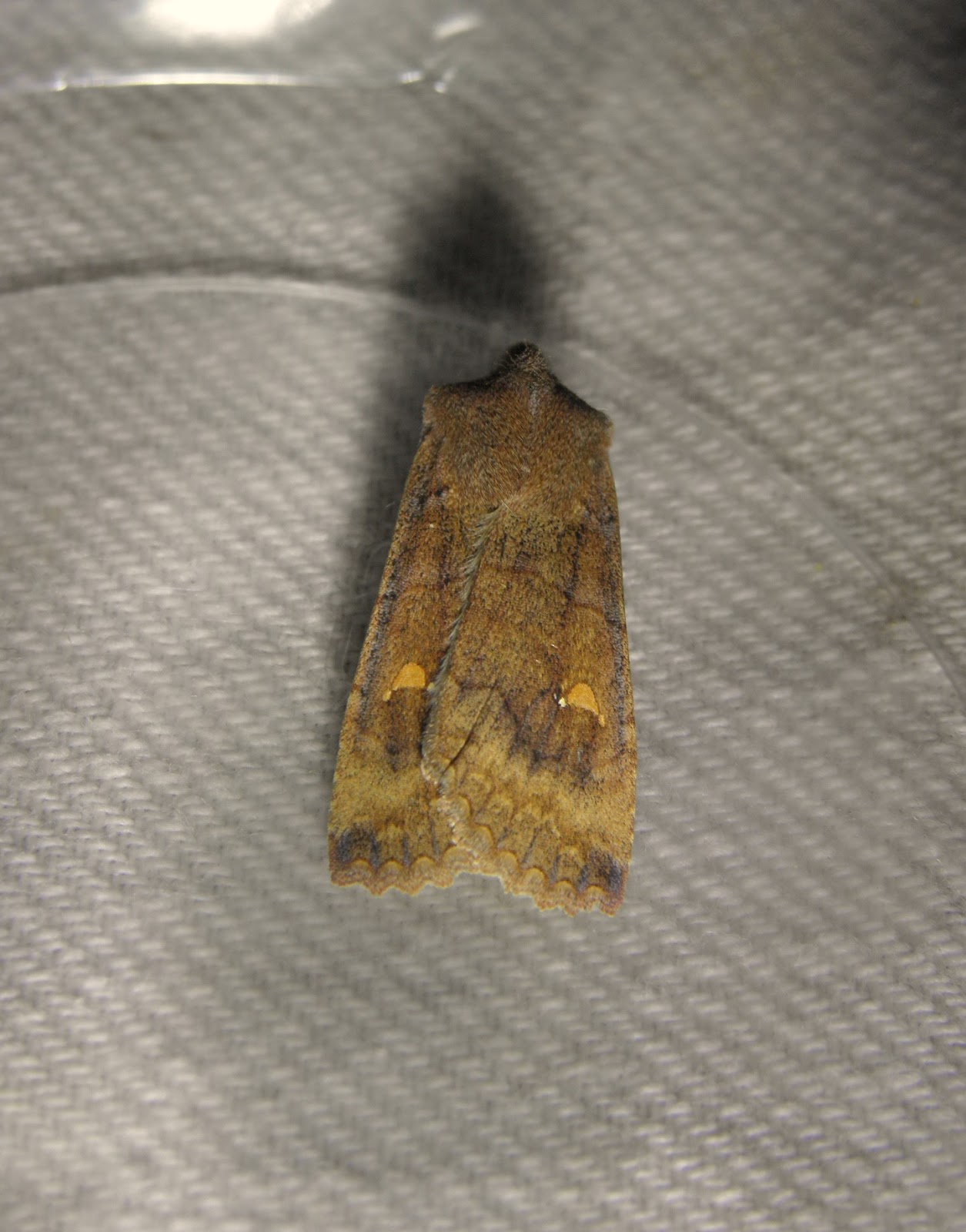
Still, out of all of this the highlight over the two nights for me was this really nice Herald pictured below.
I do find this moth is very infrequently when I trap and I'm not sure why. Very few sightings for me overall which must be my bad luck because it comes to light and is quite distinct in shape with bright autumnal colours- not easily missed!

Herald

Wednesday, 28 March 2018

10th March

Ravensnest Wood, Devauden

Small Brindled Beauty- Part 2


A visit to Ravensnest Wood this evening produced a good array of moths. The cloudy conditions at first gave way to clearing skies but at least it remained mild and fairly calm throughout the trap.
40 moths of 9 species arrived in the near 3 hours I was there with my first sighting of Yellow Horned  this year.
Yellow Horned

March Moth topped the list totalling 15 in number, but not far behind and remarkably so, was Small Brindled Beauty. I was taken aback by the 11 that came to the light and found it quite a shock that it was here in good numbers given very few have been found in the county.

One of the 11 Small Brindled Beauty that came to light this evening 

If I'm correct, I believe only 2 were found last year one from Sam Bosanquet at Dingestow and the other from myself at Chapel Hill, so a large find of this nature is very encouraging.
It covers another small 2km square for this macro moth and is within this large complex of wood in the Angiddy Valley.


Sunday, 25 March 2018

6th March

Buckle Wood, Chapel Hill

Small Brindled Beauty- Part 1


A recent discovery last year in this wood of Small Brindled Beauty prompted me to mark on the calendar for 2018, a return visit to see if this nationally localised moth was a nearby wanderer or a resident here.
This evening I set out in hope I might see it again. I had to wait patiently for quite some time but true enough it came to light once again. It is pleasing to announce it is here in much greater numbers than the single discovered in 2017. A total of 6 were recorded that night which may be a record for an evening given the data compiled by Vice county recorder Martin Anthoney as of 2015 displaying its flight season on this Blog.

I also had 2 Satellite's and another Spring Usher here which I always enjoy seeing and decided to feature on this post. Dotted Border were most numerous this evening totalling 11.

3 of the 6 Small Brindled Beauty that turned up this evening
 
Spring Usher

 Satellite 


Tuesday, 20 March 2018

19th February

Llanishen


Conditions this evening were very similar to the night before. With quite mild, murky conditions for the time of year it looked set to be a reasonable night ahead for moths. From my perspective it was good too for the most part until I had to endure a spell of heavy, drizzly rain lasting 35 minutes  which moved steadily over the site half way through the session. It did not seemed to bother the moths too much because out of the night and around the moth trap came 27 moths of 7 species, which was pleasing at a little known site.
New for the year was a single Oak Beauty, which I find takes some time to settle down when it arrives. A really nice large, colourful moth, which has alternative bands involving black speckling on white and a brownish colour which seems to hint towards purple to me in given light.
The highlight probably was Spring Usher here because its a moth that I'm finding difficult to locate in Vice county 35 at the present time even though some of the habitats chosen appear favourable.

Moths top to bottom- Oak Beauty, Spring Usher, March Moth and Dotted Border.


18th February

St. Pierre's Great Wood, Mounton


An misty, murky night with light rain was a little tough going but it seemed worth it as 16 moths of 5 species arrived.

Seen quite a few Pale Brindled Beauty this year, and this species was among them. This time a new dark form turned up, a first for me. It had me puzzled for several minutes, but getting it back, viewing it in my book and online it now makes sense, its the form monacharia, so a nice bonus.

Pale Brindle Beauty with the dark form 'monacharia' on the right

The other moth featured here is the micro Winter Shade, Tortricodes alternella.
An early emerging species that probably gets overlooked as many people tend not to be trapping out in the wilds at this time of year.
It can be quite numerous given the right habitat and indeed I have found it so on several occasions reaching into double figures.
I'm not sure if this maybe a new site for it, but perhaps Sam might be able to enlighten me on this.

Winter Shade- Tortricodes alternella

Saturday, 10 March 2018


16th February

Penhow Woodlamds NNR

- An unexpected surprise

An opportunity to get out into the woods this evening produced just 6 moths of 3 species.
There was some cloud around in the vicinity but here on site it remained clear for the most part and the temperature dropped close to a chilly 4c.
The three species that came to the trap included March Moth, Pale Brindled Beauty, (of which I ended up seeing quite a few around during February) and a big surprise Dotted Chestnut looking very fresh and bright.

I had found the Dotted Chestnut here two years ago in this wood at a slightly different location but it is very encouraging to know its status here is pretty much secure and it must be a resident.